Let’s be honest for a second.
Viral content psychology isn’t about going viral. It’s about understanding why people stop, feel, and act. If your content isn’t converting, it’s not the algorithm; it’s the psychology behind how you’re showing up.
Because you just know you’ve posted something you knew was good…
…and it got ignored.
Then something random, rushed, or slightly chaotic?
That’s the one that took off.
So now you’re wondering:
“Is this just luck?”
“Is the algorithm playing games?”
“Am I missing something obvious?”
Here’s the truth most people won’t say clearly:
Viral content isn’t random.
It’s psychological.
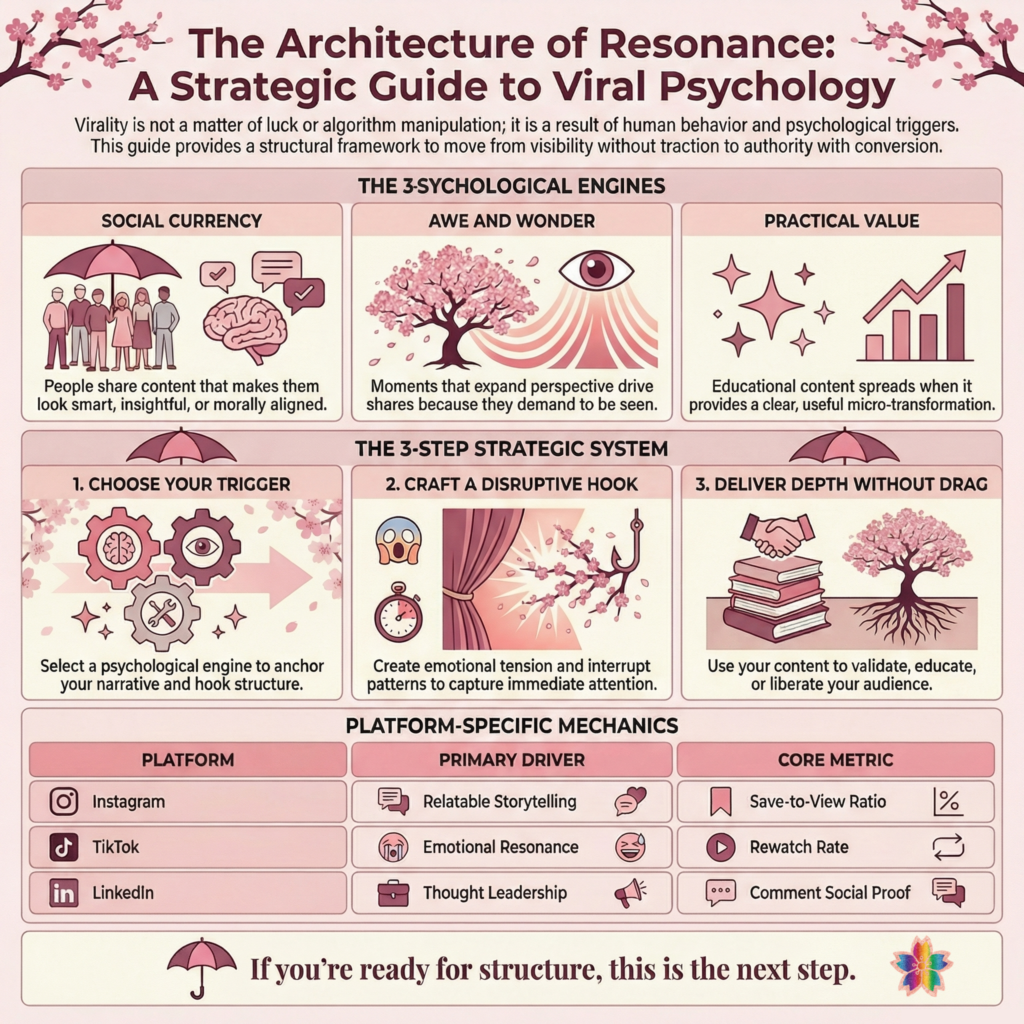
The Psychology Behind Viral Content That Sells
Really, it’s the reason that people stop, read, and interact. Every scroll, pause, like, and share is driven by one thing:
Human behavior.
Not trends.
Not hashtags.
Not even consistency on its own.
People engage with content because it activates something internally.
A reaction.
A recognition.
A moment of “wait… that’s me.”
That’s what stops the scroll.
And when you understand that, everything changes.
The 7 psychological triggers behind engagement
Most people think viral content psychology is about trends, but it’s actually about emotional recognition and behavior patterns. However almost every high-performing post taps into at least one of these:
1. Curiosity
The brain hates unfinished loops.
When something feels incomplete or unexpected, people need to resolve it.
Example:
“I almost deleted my entire business… until this happened.”
Not clickbait.
Curiosity with purpose.
2. Belonging
People don’t just want information.
They want to feel like they fit somewhere.
Content that says:
“If you’ve ever felt like this…”
creates instant connection.
Because now it’s not just content.
It’s a community.
3. Validation
Most people are walking around thinking:
“Is it just me?”
When your content names what they’ve been feeling but couldn’t explain…
They stay.
They engage.
They trust you.
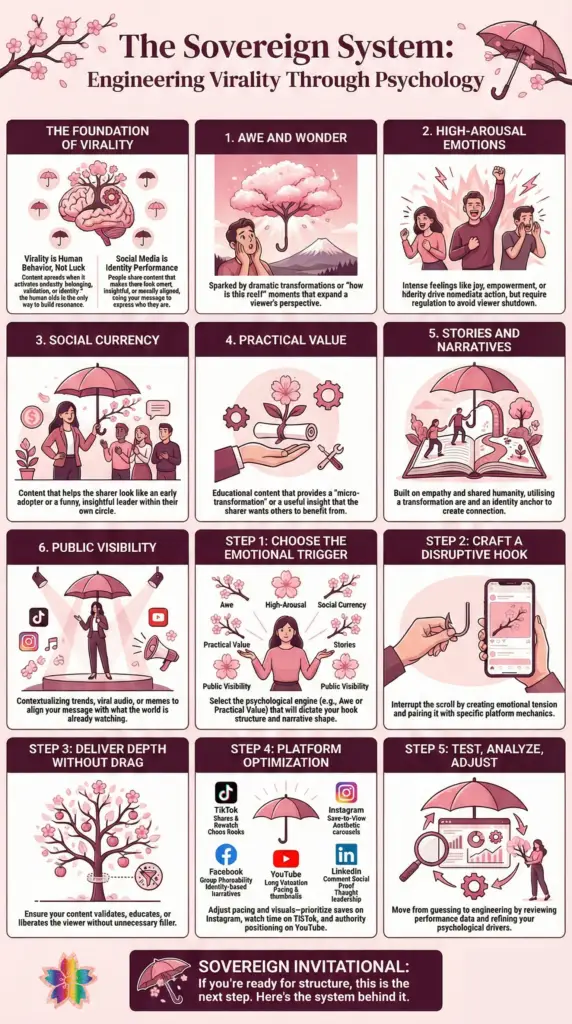
4. Identity
This is where most creators miss.
People don’t just engage with content they like.
They engage with content that reflects who they believe they are.
or who they want to become.
Example:
“You’re not inconsistent. You’ve just been taught the wrong system.”
That’s not a tip.
That’s an identity shift.
5. Authority
Not a loud authority.
Not “look at me” authority.
Calm, grounded, been-through-it authority.
People trust content that feels like:
“This person knows what they’re talking about… and they get me.”
6. Emotional Contrast
The brain notices change.
Surprise.
Relief.
Shock.
Reframe.
Anything that breaks expectation creates a pause.
And that pause is where engagement starts.
7. Transformation
People don’t just want information.
They want proof that change is possible.
Content that shows:
- before → after
- confusion → clarity
- chaos → structure
will always outperform surface-level tips.
Why most content doesn’t land
It’s not because you’re bad at content.
It’s because most content is built like this:
Information → Advice → Post
But high-performing content follows a different structure:
Trigger → Recognition → Meaning → Action
If there’s no psychological entry point…
There’s no reason for the brain to stop.
The missing layer: identity-driven psychology
Here’s where we go deeper than most marketing advice and get into viral content psychology.
Triggers get attention.
But identity creates attachment.
This is why two creators can use the same “hook”…
…and get completely different results.
Because the audience isn’t just reacting to the words.
They’re reacting to how those words align with:
- who they are
- what they believe
- what they’ve experienced
This is where content moves from:
seen → felt → remembered
How to start using this (without overcomplicating it)
You don’t need 50 new strategies.
You need one shift.
Before you post, ask:
- What emotion does this activate?
- What identity does this speak to?
- What recognition moment does this create?
If you can answer those…
Your content will land differently. It becomes connected as that viral content that everyone is craving.
Let’s make Viral Content Psychology Practical!
If you’re looking at your content thinking:
“I’m showing up… but it’s not connecting the way it should”
That’s not a motivation problem.
That’s a psychology gap.
Want the exact viral content psychology breakdown?
I put together a Psychological Hook Cheat Sheet that shows you:
- the most effective triggers
- how to use them ethically
- real examples you can adapt immediately
 GET IT HERE ONLY $7
Final thought
You don’t need to go viral.
You need to be understood.
Because when people feel seen,
they don’t just engage.
They stay.

Karen Hewitt