If you’ve seen chatter about Facebook limiting how many links you can post each month, you’re not imagining it. But the internet has, as usual, taken a partial test and turned it into a full-blown panic spiral.
Let’s slow this down and look at what’s actually happening, why Meta is doing it, and what smart businesses should do next.
What Meta Is Testing Right Now
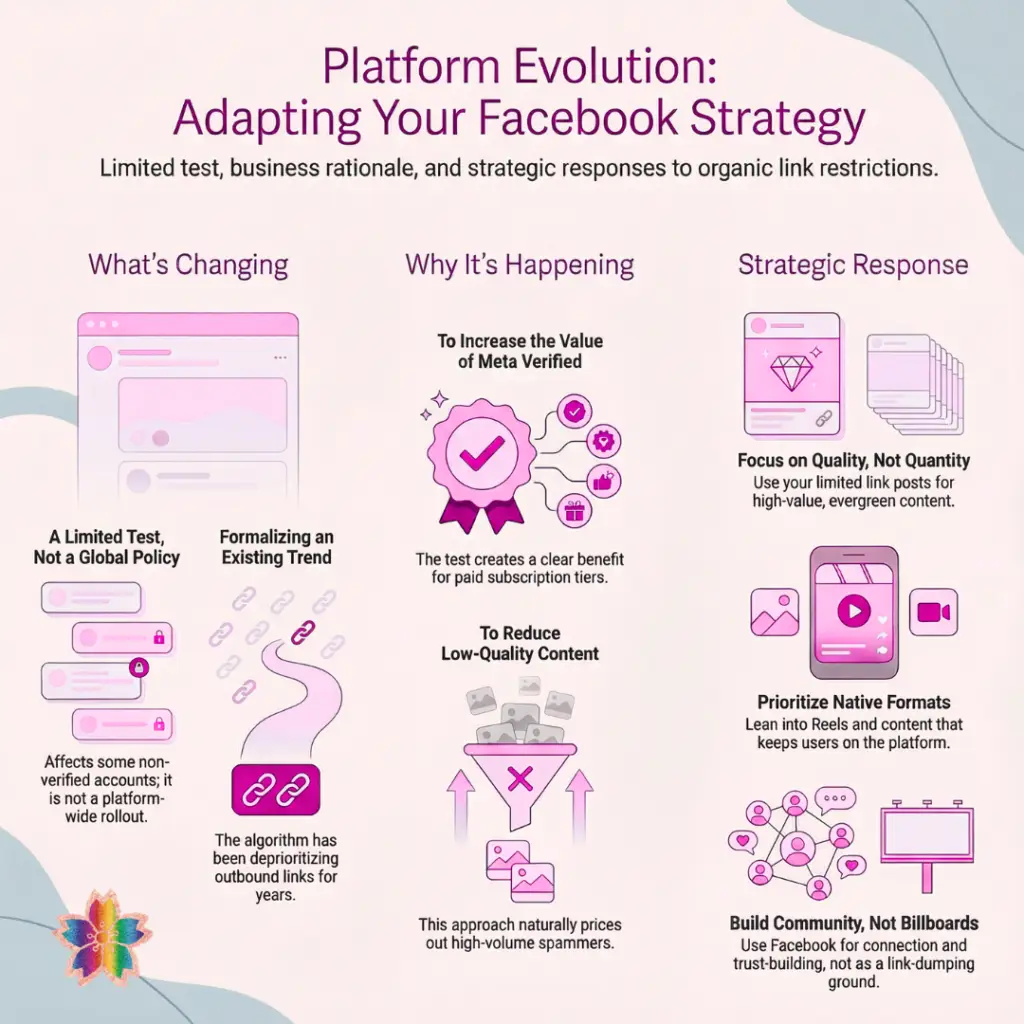
Meta is currently running a limited test that affects some Facebook profiles and Pages.
Here’s what we know so far:
Certain profiles, including Pages and professional mode accounts without Meta Verified, are being limited to two organic link posts per month
The test began rolling out around December 16
This is not platform-wide and not everyone is affected
Publisher Pages are not included in this test at this time
In other words, this is a controlled experiment, not a global policy shift. Yet.
Why Meta Is Doing This
Meta has openly stated the purpose of the test:
They want to see whether increased posting privileges create more value for Meta Verified subscribers.
Translation, this is a monetization test.
Meta Verified is a paid subscription that offers:
A verified badge
Identity protection
Increased support
Potential feature prioritization, including posting capabilities
For business users, pricing ranges widely, from $14.99 per month up to several hundred dollars, depending on the package and account type.
From Meta’s perspective, this is considered low risk for one simple reason:
Link posts already get very little reach.
That reach has been declining for years. This test doesn’t meaningfully disrupt user experience because the algorithm already deprioritizes outbound links.
There’s also a secondary benefit for Meta. Charging for link volume naturally prices out large-scale spammers who rely on blasting links across hundreds of Pages.
Important Context People Are Missing
This is the part that matters most.
Facebook is not saying, “Links are bad.”
They are saying, “Unfiltered, high-volume link posting is not valuable to the platform.”
That’s a distinction many businesses have ignored for a long time.
The algorithm has been moving in this direction for years:
Less reach for direct links
More emphasis on native content
Higher prioritization of Reels, conversations, and time-on-platform behaviors
This test simply formalizes what has already been happening quietly.
Your Strategic Options If You’re Affected
If your Page or profile is part of this test and you choose not to subscribe to Meta Verified, you still have options.
Smart ones.
Be intentional with your links
If you only have two link posts per month, they should be:Evergreen
High-converting
Strategically timed
This forces quality over noise.
Shift links into context, not content
Many businesses already succeed by:Posting value-first content
Referencing the link verbally
Directing people to comments or bio paths
Even that method is being tested, so don’t rely on a single workaround.
Lean into Reels and native formats
Reels are currently the strongest organic reach tool on Facebook.
They:Keep users on-platform
Signal engagement quality
Build familiarity before conversion
Rethink Facebook’s role in your ecosystem
Facebook should not be your only traffic source.
It works best as:A trust builder
A community space
A conversation engine
Not a link-dumping ground.
The Bigger Picture for Business Owners
This test isn’t about punishment.
It’s about pressure.
Pressure to:
Build brands, not just funnels
Create content people actually engage with
Stop treating social platforms like free billboard space
If your entire strategy depends on dropping links and waiting for clicks, this isn’t a Meta problem. It’s a strategy gap.
The businesses that will thrive moving forward are the ones that:
Build attention before asking for action
Use platforms for connection, not extraction
Design systems that don’t collapse when one feature changes
Final Thought
Meta will continue testing monetization levers. That’s not new.
Algorithms will continue changing. That’s guaranteed.
The only sustainable strategy is one built on:
Trust
Visibility that doesn’t rely on loopholes
Content that earns attention instead of demanding it
Choose clarity over chaos.
Platforms change. Strategy adapts.
And this is exactly the moment to adapt on purpose, not out of fear.
Is Facebook limiting link posts for everyone?
No. Meta is currently running a limited test affecting only some profiles and Pages.
How many links can you post on Facebook now?
Some accounts in the test are limited to two organic link posts per month unless subscribed to Meta Verified.
Does Meta Verified increase link posting?
Yes. Meta has stated this test is designed to evaluate added value for Meta Verified subscribers.
Are Facebook links getting less reach?
Yes. Link posts have seen declining organic reach for years as Meta prioritizes on-platform engagement.
What should businesses do instead of posting links?
Focus on native content, Reels, conversation-driven posts, and strategic link placement.

Karen Hewitt