Should a solopreneur build a personal brand or a business brand?
It’s one of the most common branding questions entrepreneurs ask when they’re trying to grow their visibility and scale their business.
If you’re a solopreneur, coach, consultant, creator, freelancer, or service provider, you’ve probably heard conflicting advice.
Some experts say:
“People buy from people.”
Others insist:
“Build a business brand so you can scale.”
Both are partially correct.
The problem is that most advice ignores how modern trust actually works.
Today, people don’t buy based solely on logos.
They buy based on connection, credibility, and confidence.
The real decision isn’t between personal and business brands.
It’s understanding when each one serves your growth. Which is why understanding whether you should build a personal brand or a business brand is key.
What Is a Personal Brand?
A personal brand is built around you.
Your:
- story
- expertise
- opinions
- experiences
- personality
People follow because they connect with the human behind the business.
Examples include creators, consultants, speakers, coaches, authors, and industry experts whose reputation becomes their biggest asset.
The audience isn’t just buying a service.
They’re buying access to your perspective.
Benefits of Building a Personal Brand
Faster Trust
Trust is the most valuable currency online.
People naturally connect with faces faster than logos.
When they see your story, your beliefs, and your expertise, trust forms quicker.
This is one reason many solopreneurs grow faster through personal branding than traditional business marketing.
Easier Content Creation
It’s often easier to create content about:
- lessons learned
- experiences
- opinions
- successes
- failures
Instead of constantly trying to make a company seem relatable, you simply show up as yourself.
Higher Engagement
People engage with people.
A founder sharing insights often outperforms a company page sharing the exact same information.
This is especially true on social media platforms where connection drives visibility. Trust-building content consistently outperforms direct selling content in long-term audience growth.
The Downsides of a Personal Brand
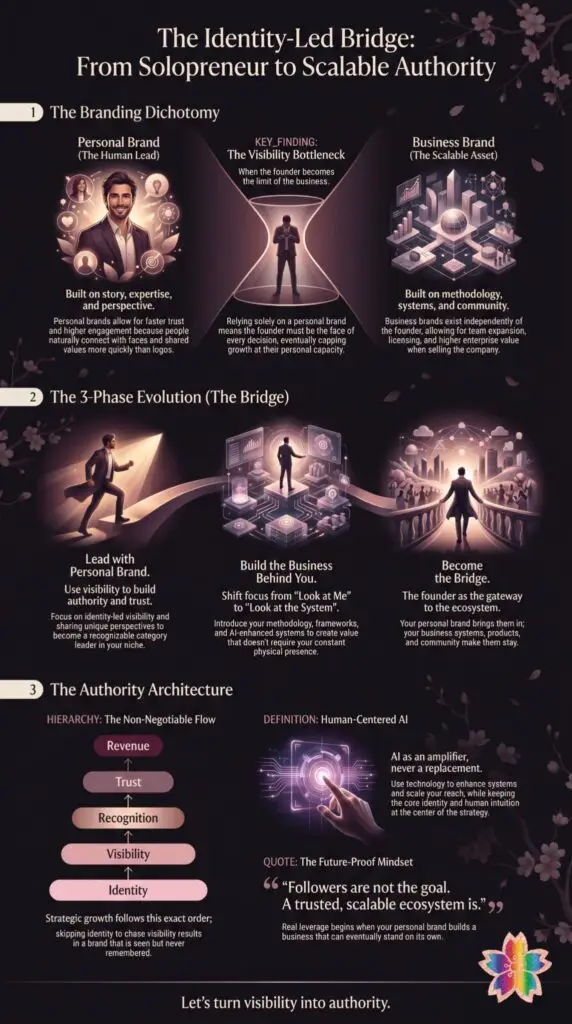
A personal brand can create dependency.
If everything revolves around you:
- You become the marketing department.
- You become the sales team.
- You become the content creator.
- You become the face of every decision.
Eventually, growth can become limited by your personal capacity.
This is where many successful solopreneurs experience what I call a visibility bottleneck.
The audience loves the founder.
But the business struggles to exist without them.
What Is a Business Brand?
A business brand exists independently from a specific individual.
Think about companies that are known for:
- a mission
- a process
- a methodology
- a community
- a movement
The focus shifts from:
“Look at me.”
To:
“Look at what we do.”
Benefits of Building a Business Brand
Greater Scalability
A business brand can:
- add team members
- expand services
- license intellectual property
- create certifications
- develop partnerships
without requiring the founder to be everywhere.
Easier Long-Term Expansion
Business brands allow you to build assets beyond yourself.
You can create:
- courses
- communities
- certifications
- software
- memberships
- products
that continue growing regardless of how visible you personally are.
Higher Enterprise Value
If one day you want to sell the business, a brand that exists independently of the founder is often easier to transfer.
The Downsides of a Business Brand
Business brands usually grow slower at the beginning.
Why?
Because businesses must earn trust before they earn attention.
People don’t automatically care about a company.
They care about what the company means to them.
Without a human face attached, building that emotional connection takes longer.
Why Most Solopreneurs Should Build Personal Brand or a Business Brand - HINT It's The First One
For most solopreneurs, personal branding is the fastest path to visibility.
You already have:
- expertise
- experiences
- opinions
- lessons
- stories
These become content assets immediately.
Research and modern content strategy consistently show that trust, authority, and relationship-building drive conversions more effectively than constant promotion. Educational and relationship-driven content often creates stronger buyer readiness than direct selling alone.
People don’t connect with businesses first.
They connect with humans first.
Then they trust the business behind them.
The Smartest Strategy: Build Both
This is where most advice falls apart.
You don’t actually need to choose one forever.
The strongest modern brands use both.
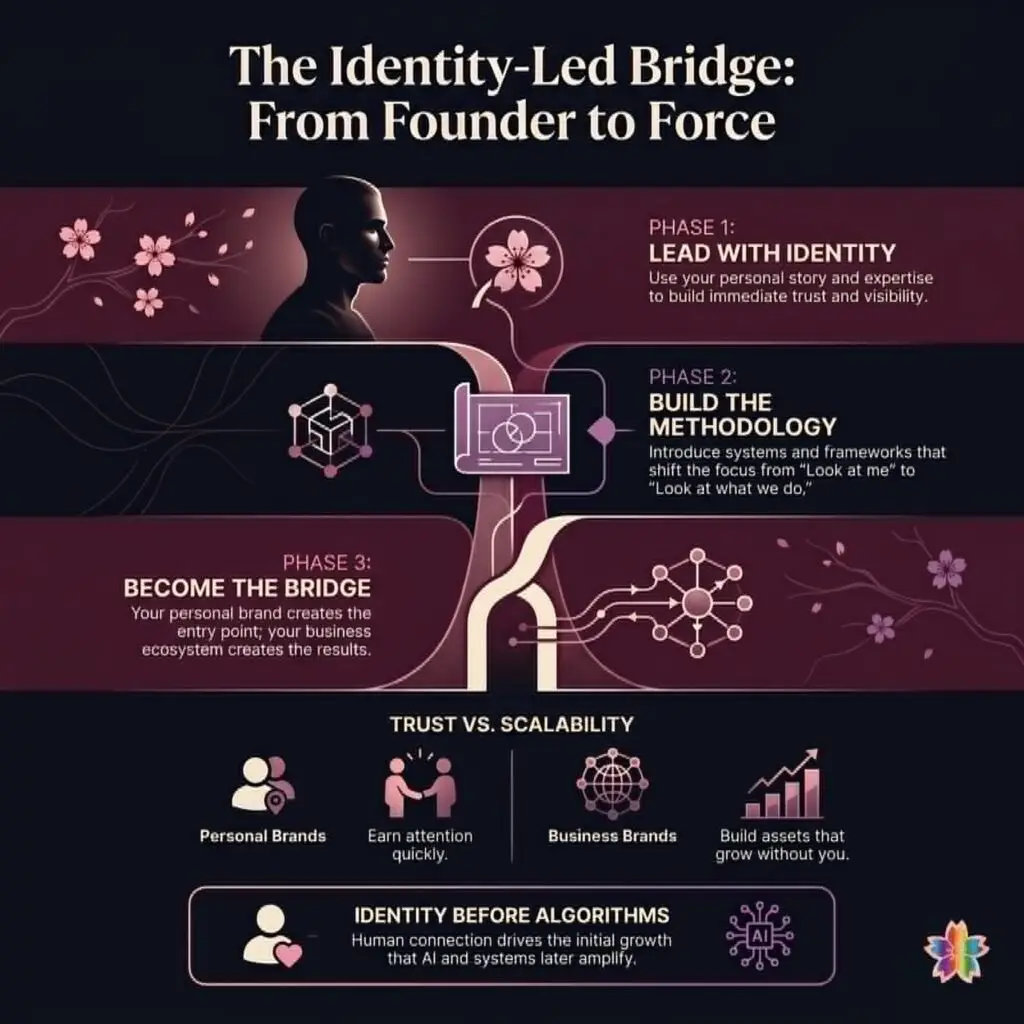
Phase 1: Lead With the Personal Brand
Use your visibility to build:
- trust
- authority
- audience
- credibility
Share your expertise.
Share your perspective.
Become known.
Phase 2: Build the Business Behind You
As trust grows, introduce:
- your methodology
- your systems
- your framework
- your community
- your products
Shift attention from:
“Look at me.”
to
“Look at the ecosystem.”
Phase 3: Become the Bridge
At this stage, you are no longer the entire business.
You are the gateway to it.
Your audience enters through your personal brand and stays because of the value created by the business.
The Future-Proof Approach
The strongest solopreneur brands today are not asking, ” Should a solopreneur build a personal brand or a business brand? “
They are building a bridge between the two.
Your personal brand creates trust.
Your business brand creates scalability.
Your systems create sustainability.
That’s the real move.
Because followers are not the goal.
A recognizable, trusted, scalable ecosystem is.
And if you’re building for the long game, the question isn’t:
“Personal brand or business brand?”
It’s:
“How do I use my personal brand to build a business that can eventually stand on its own?”
That’s where real leverage begins.

Karen Hewitt