A lot of marketing advice still sounds like this:
“Know your audience.”
Cool.
But if your version of “knowing your audience” is only:
- age
- gender
- income
- location
You’re probably missing the real psychology.
Because demographics may tell you who someone is on paper…
But identity tells you how they move.
And that changes everything.
Here’s what I mean:
Two women can both be:
35
moms
entrepreneurs
Same demographic.
Completely different psychology.
One may feel:
overwhelmed
frozen
terrified of making the wrong move
The other may feel:
ambitious
ready to reinvent
craving expansion
Same stats.
Different nervous systems.
Different buying patterns.
Different messaging needs.
This is why generic content underperforms.
Because “women entrepreneurs” is not specific enough.
You’re not just speaking to a category.
You’re speaking to a lived experience.
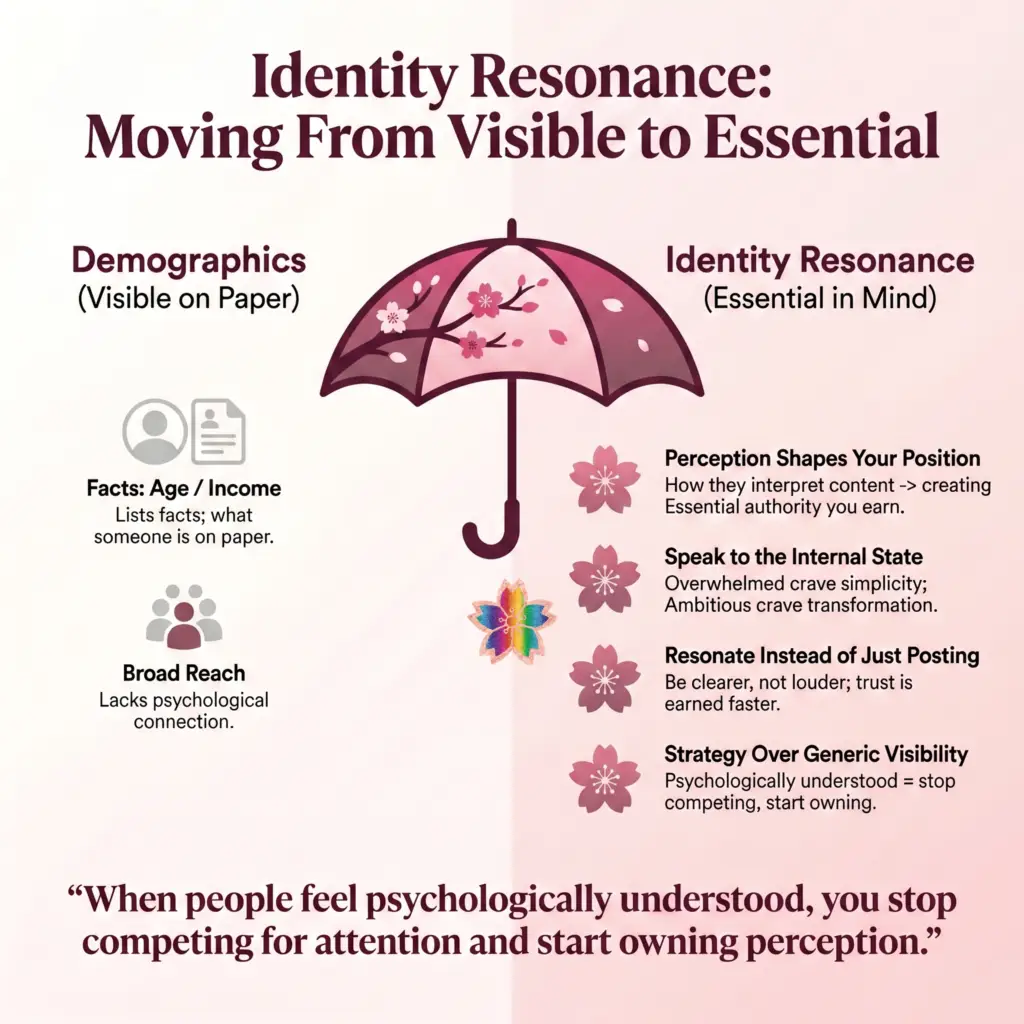
Enter: Identity-Led Marketing
This is where you stop asking:
“Who are they?”
And start asking:
“What state are they in?”
Because someone’s identity shapes:
what they notice
what they trust
what they avoid
what feels safe
For example:
The overwhelmed person wants:
clarity
simplicity
relief
The cautious person wants:
trust
proof
consistency
The ambitious identity-expander wants:
transformation
elevation
possibility
See the difference?
Your offer may technically solve all three…
But your messaging cannot sound the same.
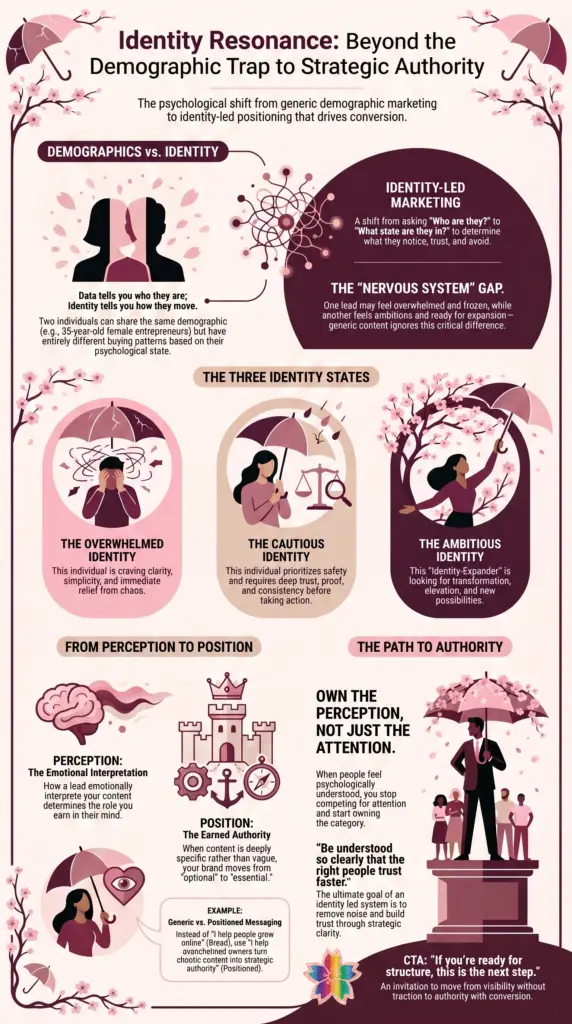
This is Perception → Position.
Perception:
How someone emotionally interprets your content.
Position:
The role you earn in their mind because of that perception.
If your content feels vague…
You become forgettable.
If your content feels deeply specific…
You become relevant.
Example:
Generic:
“I help people grow online.”
Positioned:
“I help overwhelmed business owners turn chaotic content into strategic authority.”
One is broad.
One immediately creates perception.
And perception shapes whether someone sees you as:
optional
or
essential
This is the deeper game.
Marketing is not just visibility.
It is identity resonance.
The goal is not simply:
“Get seen.”
The goal is:
“Be understood so clearly that the right people trust faster.”
This also changes content strategy.
Instead of posting randomly…
You start creating intentionally.
You create content that:
attracts
positions
nurtures
converts
Not because you’re louder.
Because you’re clearer.
Final Thought
If your content feels like it’s “good” but not landing…
You may not have a content problem.
You may have an identity problem.
Because generic visibility is easy.
Strategic positioning is what builds authority.
So ask yourself:
Who am I actually speaking to?
What identity are they protecting?
What transformation are they craving?
Because when people feel psychologically understood…
You stop competing for attention.
You start owning perception.

Karen Hewitt