Why some content gets ignored… and some content becomes unforgettable
Here’s the truth:
Going viral is rarely random.
Yes, timing matters.
Yes, platform matters.
But beneath every post that stops the scroll is something deeper:
Human psychology and the psychology of viral content.
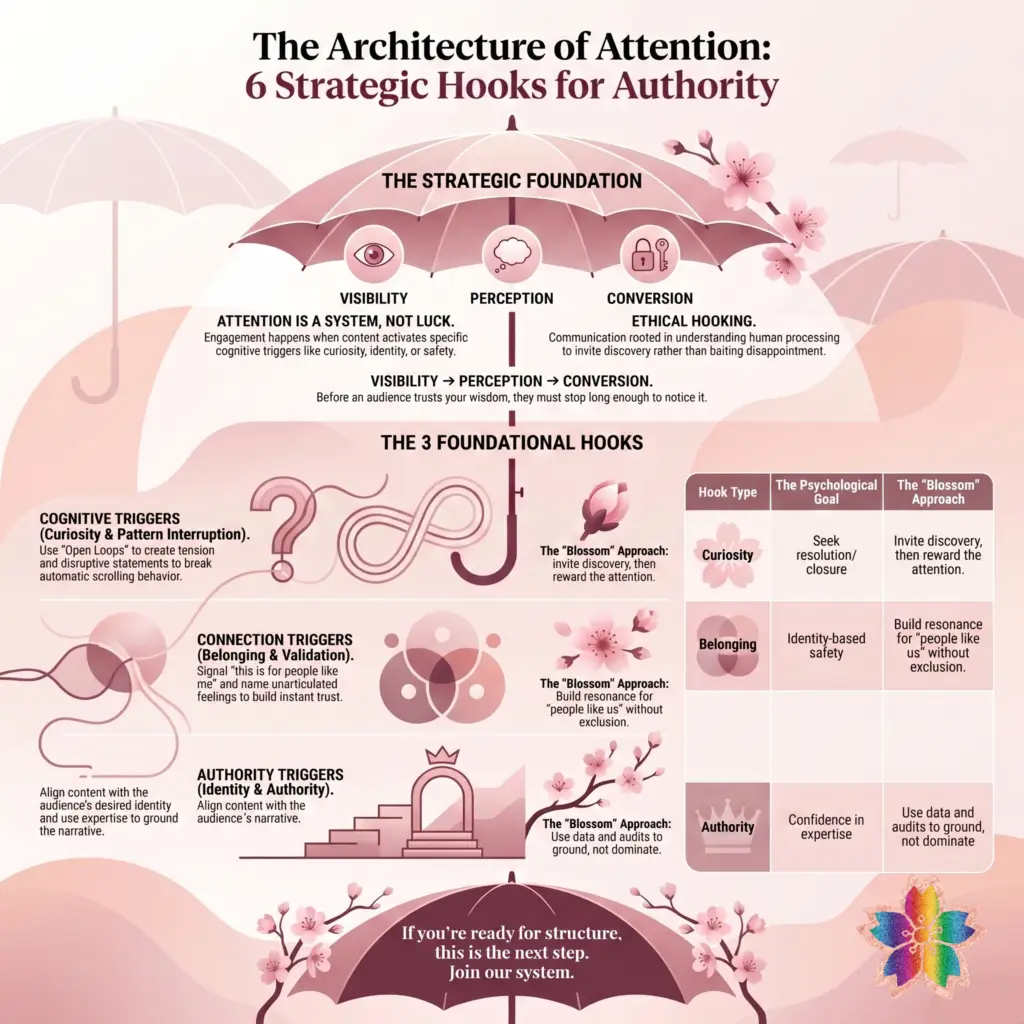
People don’t engage because content simply exists.
They engage because something inside that content activates curiosity, identity, emotion, belonging, or trust.
That activation is what we call a psychological hook.
And when used ethically, hooks are not manipulation.
They’re communication rooted in understanding how humans actually process information.
As explored through behavioral psychology, persuasion frameworks, and ethical virality systems, attention is often driven by recognizable emotional and cognitive triggers like curiosity gaps, authority, belonging, validation, and pattern interruption.
The 12 Hooks That Lean To The Psychology of Viral Content
These are the 12 core hooks every creator, business owner, and marketer should understand:
1. Curiosity
2. Belonging
3. Pattern Interruption
4. Validation
5. Identity Signaling
6. Authority
7. Novelty
8. Tribal Signals
9. Scarcity
10. Emotional Contrast
11. Safety
12. Rebellion
In this guide, we’re breaking down the first 6 foundational psychology of viral content hooks because mastering these alone can radically shift how your content connects.
For hooks 7–12 and deeper implementation frameworks, you’ll find the full breakdown inside our free Facebook group.
1. Curiosity: The Brain Wants Closure
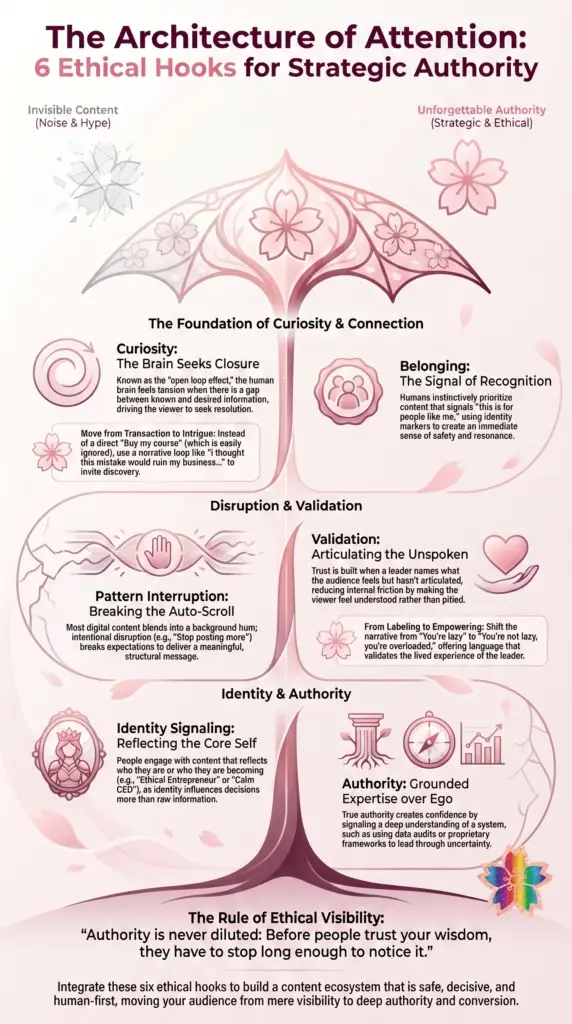
Curiosity works because the human brain dislikes unfinished information.
This is often called the open loop effect.
When people sense there’s a gap between what they know and what they want to know, they pause.
Example:
❌ “Buy my course.”
✅ “I thought this mistake would ruin my business…”
Why it works:
Curiosity creates tension.
The brain seeks resolution.
Ethical Use:
Curiosity should invite discovery, not bait disappointment.
Key Reminder:
If your hook creates intrigue, your content must reward attention.
2. Belonging: People Want To Feel Seen
Humans are wired for connection.
We instinctively pay attention when something signals:
“This is for people like me.”
Example:
• “For overwhelmed moms building businesses…”
• “For neurodivergent entrepreneurs…”
• “For small businesses tired of invisible content…”
Why it works:
Belonging taps into identity and safety.
Ethical Use:
Build resonance, not exclusion.
Key Reminder:
People stay where they feel recognized.
3. Pattern Interruption: Break Automatic Scrolling
Most content blends in.
Pattern interruption breaks expectation.
Example:
• “Stop posting more.”
• “Your problem isn’t motivation.”
• “More content may actually be hurting you.”
Why it works:
The brain notices disruption.
Ethical Use:
Disrupt for clarity, not shock alone.
Key Reminder:
Interrupt attention, then deliver meaning.
4. Validation: Recognition Builds Trust
Sometimes the strongest hook is simply naming what someone already feels but hasn’t articulated.
Example:
• “You’re not lazy, you’re overloaded.”
• “You don’t need more ideas, you need clearer execution.”
Why it works:
Validation reduces internal friction.
Ethical Use:
Offer language, not pity.
Key Reminder:
People trust those who make them feel understood.
5. Identity Signaling: People Protect Who They Believe They Are
People often engage with content that reflects either:
Who they are
or
Who they want to become
Example:
• Ethical entrepreneur
• Disruptive thinker
• Calm CEO
• Authentic leader
Why it works:
Identity influences decisions more than information alone.
Ethical Use:
Invite expansion, not insecurity.
Key Reminder:
When content aligns with identity, it becomes personal.
6. Authority: Trust Accelerates Attention
Authority is not about ego.
It’s about creating confidence that says:
“I understand this deeply enough to lead here.”
Example:
• “After auditing 100+ brands…”
• “Here’s what the data actually says…”
Why it works:
People trust expertise when uncertainty is high.
Ethical Use:
Use authority to ground, not dominate.
Key Reminder:
True authority feels safe, not performative.
Why This Matters
If your content is thoughtful but invisible…
If your posts are educational but ignored…
If your offers are valuable but not converting…
You may not have a value problem.
You may have a hook problem.
Because before people trust your wisdom…
They have to stop long enough to notice it.
Want Hooks 7–12?
Inside the FREE Facebook group, we go deeper into:
Novelty
Tribal Signals
Scarcity
Emotional Contrast
Safety
Rebellion
Plus:
✔ Ethical examples
✔ Content applications
✔ Hook templates
✔ Psychology-backed strategy
Because visibility is not just about posting more.
It’s about understanding what makes humans pause, feel, and remember.
FAQ’s
What are psychological hooks in marketing?
Psychological hooks are emotional or cognitive triggers like curiosity, belonging, and authority that capture attention and increase engagement.
What makes content go viral?
Viral content often combines timing, platform behavior, and psychological triggers that create emotional resonance or curiosity.
Are psychological hooks manipulative?
Not inherently. Ethical hooks communicate effectively by aligning with how humans process information without deception.

Karen Hewitt