For years, businesses were taught that understanding their audience meant knowing things like age, gender, income level, and location.
And for a long time, that worked well enough.
But something fundamental has changed.
Today, two people of the same age, gender, and income can respond completely differently to the exact same message. One will feel seen. The other will scroll right past it.
That’s not a coincidence. It’s a signal.
The era of demographic-first marketing is ending, and it’s being replaced by something far more accurate, human, and effective: identity-led marketing audience strategy.
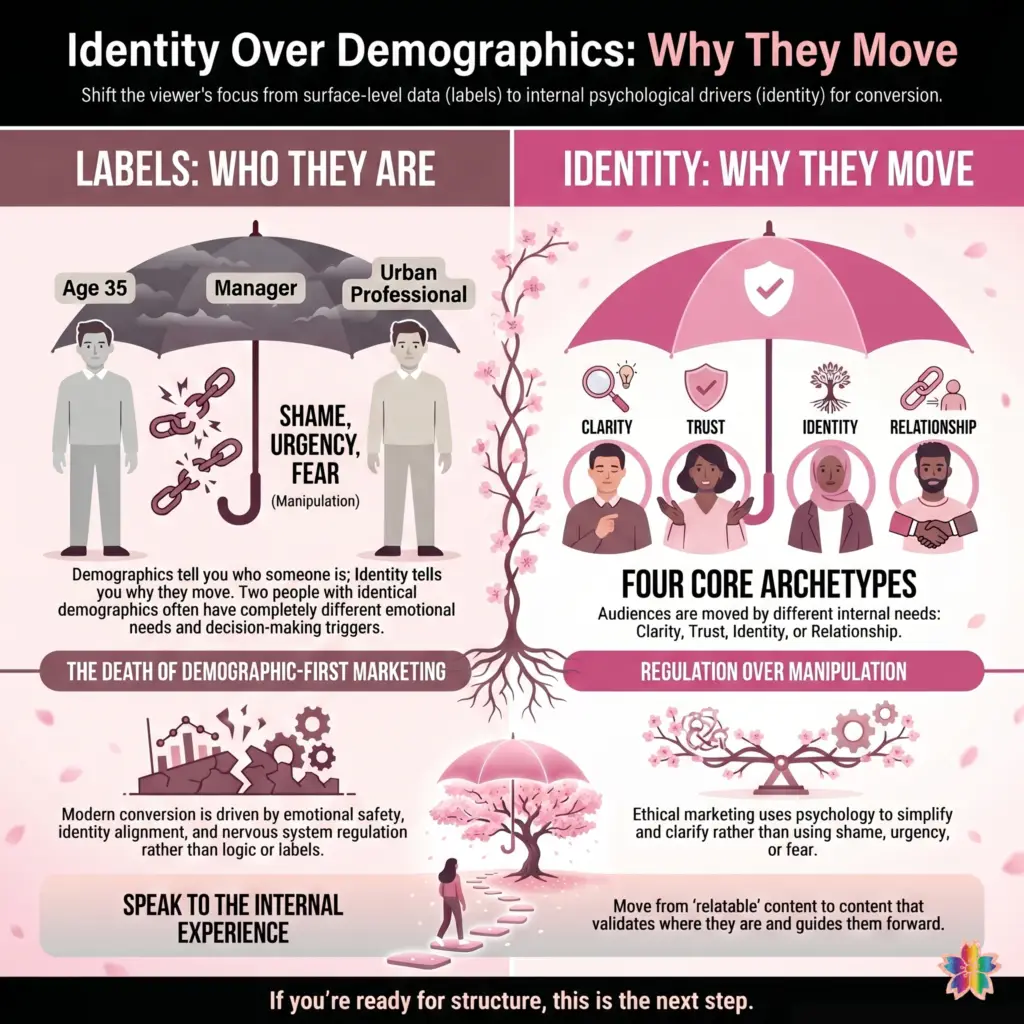
The Problem With Demographics
Demographics tell you who someone is on paper.
They do not tell you:
- What they’re afraid of
- What they’re craving emotionally
- How their nervous system responds to pressure
- Why they buy
- What makes them hesitate
- What kind of leadership they need
- What kind of language makes them feel safe or activated
Two 35-year-old women running small businesses may look identical in a marketing spreadsheet, but one might be overwhelmed and seeking clarity, while the other is ambitious and craving expansion. This is where we start looking at Identity-led Marketing.
If you market to them the same way, you miss both.
This is why so many businesses feel like they are “doing everything right” but not seeing engagement convert into trust or sales.
They’re speaking to categories, not people.
The Shift: From Demographics to Identity-led Marketing
Modern audiences don’t make decisions primarily based on logic or labels.
They decide based on:
- Emotional safety
- Identity alignment
- Nervous system regulation
- Trust
- Self-perception
- Who they believe they are becoming
This is where identity-led audience archetypes come in.
Instead of asking:
“How old is my audience?”
“Are they male or female?”
“What industry are they in?”
We ask:
What are they seeking emotionally right now?
What state is their nervous system in when they find me?
What identity are they protecting?
What identity are they trying to step into?
This shift is not theoretical. It is observable in how people engage, hesitate, ghost, binge content, DM silently, or buy impulsively.
Identity-Led Marketing Archetypes Explained
An identity-led archetype is not a personality test.
It’s a pattern of emotional needs, decision-making psychology, and regulation style that shows up consistently in how someone consumes content and chooses support.
For example:
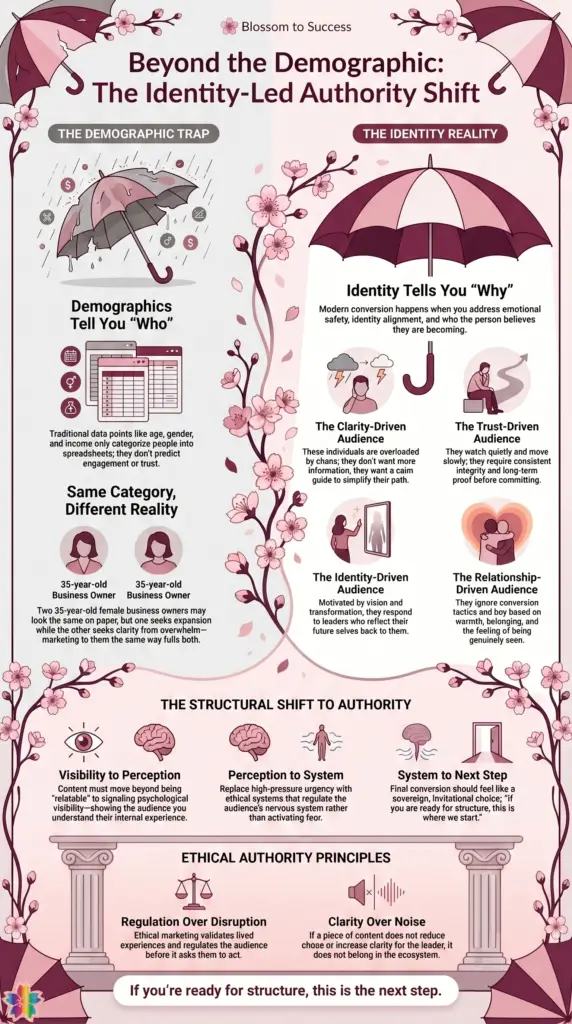
Some audiences are clarity-driven.
They’re overwhelmed, overloaded, and afraid of choosing wrong. They don’t want more information. They want someone to simplify the chaos and guide them calmly.
Some are trust-driven.
They watch quietly. They read everything. They don’t rush. They need consistency and integrity before they commit, and once they do, they’re deeply loyal.
Others are identity-driven.
They feel a pull toward becoming more. They resonate with vision, transformation, and embodiment. They respond to leaders who reflect their future self back to them.
And some are relationship-driven.
They buy because of connection, not conversion tactics. They want warmth, belonging, and to feel genuinely seen.
None of these needs show up in demographic data.
But they show up clearly in behavior.
Why This Matters for Content
When content fails today, it’s rarely because it’s poorly written or inconsistent.
It fails because it speaks to the wrong internal experience.
Relatable content alone builds connection but not confidence.
Educational content alone builds authority but not trust.
Aspirational content alone inspires but can also overwhelm.
Identity-led strategy is about balance.
You create content that says:
“I see where you are.”
“I understand what you need.”
“And I know how to guide you forward.”
That combination is what converts without pressure.
This Is Not About Manipulation
There’s an important distinction here.
Identity-led marketing is not about exploiting emotions.
It’s about respecting them.
When you understand what someone is carrying internally, you stop using shame, urgency, and fear as motivators.
You simplify instead of overwhelm.
You clarify instead of confuse.
You invite instead of pressure.
Ethical marketing doesn’t ignore psychology. It uses it responsibly.
The Businesses Winning Right Now Understand Identity-Led Marketing
The brands building loyalty, referrals, and long-term clients aren’t louder.
They aren’t posting more.
They aren’t chasing trends endlessly.
They’re precise.
They speak to emotional reality.
They meet people where they are.
They design content for how people actually decide.
Demographics tell you who someone is.
Identity tells you why they move.
And in today’s market, that difference is everything.
If your content feels like it’s not landing the way it should, the problem may not be consistency, effort, or quality.
It may simply be that you’re still speaking to labels instead of identities.
That’s where the real shift begins.

Karen Hewitt