Most people think they have a positioning problem. And when it comes to perception vs positioning, that assumption is usually where things go wrong.
They tweak their bio.
Rewrite their offer.
Change their content style.
Second-guess their niche.
But what’s actually costing them visibility and sales isn’t positioning alone.
It’s the gap between perception and positioning.
And until that gap is addressed, nothing quite sticks.
What positioning actually is
Positioning is internal.
It’s how you describe what you do.
It’s the language you choose.
It’s the role you believe your brand plays in someone’s life.
Positioning lives in strategy documents, brand notes, and your own head.
And it matters. A lot.
But positioning only works if it translates.
What perception actually is
Perception is external.
It’s what people understand when they land on your profile.
It’s the story they piece together from your content.
It’s the feeling they walk away with after scrolling.
Perception is formed fast. Often subconsciously.
The real issue isn’t positioning alone. It’s perception vs positioning, and whether the story in your head matches the story forming in your audience’s mind.
Your audience is not analyzing your brand the way you are.
They are sensing it.
And sensing always comes before trusting.
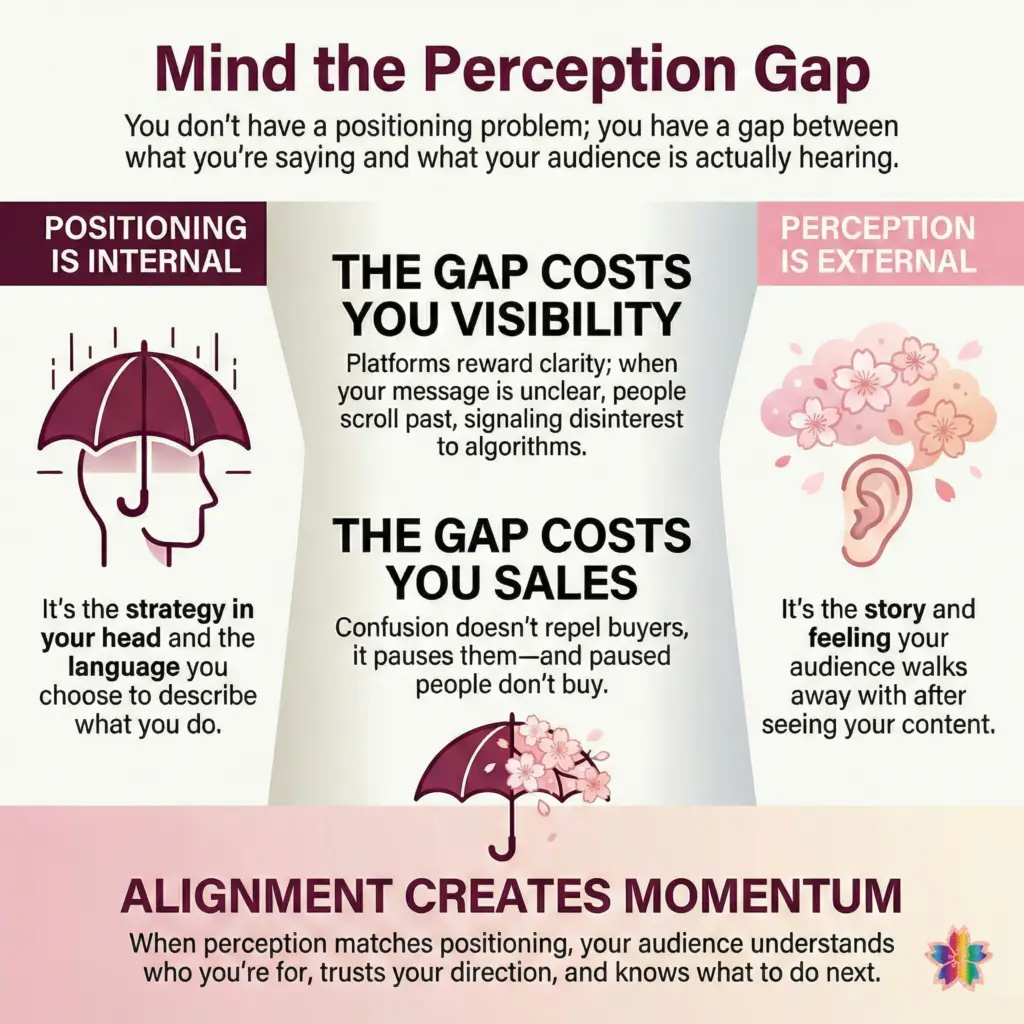
Where the perception vs positioning gap forms
The perception gap forms when these two things drift apart:
What you think you’re communicating
What your audience actually understands
This is how you end up with:
People misunderstanding your offer
Engagement that exists but doesn’t convert
Sales that come in waves instead of steadily
Conversations that feel close but never quite land
Nothing is broken. It’s just misaligned.
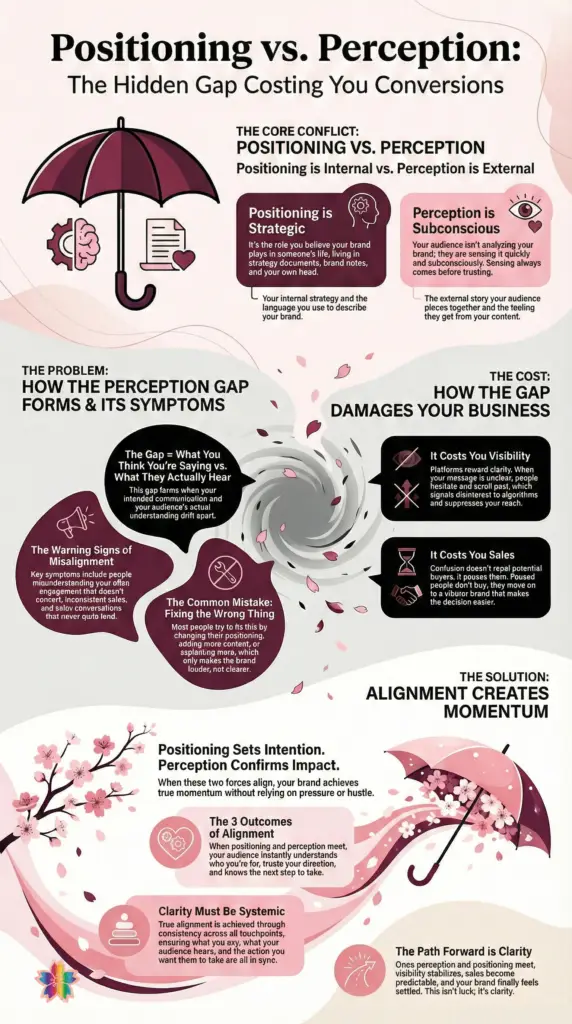
Why this gap costs you visibility
Platforms reward clarity.
When people understand you quickly, they engage faster.
When they engage faster, algorithms respond.
When your message is unclear, people hesitate.
They scroll past instead of interacting.
That hesitation signals disinterest, even when interest exists.
This is why some brands with smaller audiences outperform larger ones.
They are easier to understand.
Clarity compounds.
Why this gap costs you sales
Confusion doesn’t repel people.
It pauses them.
And paused people don’t buy.
If someone has to work to understand what you do, they won’t.
They’ll move on to the brand that makes the decision easier.
This is not about dumbing things down.
It’s about removing friction.
Trust builds when people feel oriented.
The common mistake people make in perception vs positioning
Most people try to fix perception issues by adjusting positioning alone.
They rewrite their messaging without checking how it’s being received.
They add more content without correcting the signal.
They explain more instead of clarifying better.
That’s how brands get louder without becoming clearer.
How perception and positioning work together
Positioning sets intention.
Perception confirms impact.
When they align, three things happen at once:
People understand who you’re for
They trust your direction
They know what to do next
This is where momentum comes from.
Not pressure.
Not hustle.
Alignment.
Why clarity has to be systemic
True brand clarity isn’t about one post or one page.
It’s about consistency across touchpoints.
What you say.
What your audience hears.
The action you want them to take.
When those three sync, your brand stops feeling fragile.
You stop overthinking.
And your audience starts responding with confidence.
When perception vs positioning are aligned, clarity replaces hesitation and momentum follows.
This is the work most people skip
Because perception feels harder to measure than positioning.
But it’s the missing layer.
And it’s exactly why the Perception to Position Audit exists.
Not to critique your brand.
Not to tear it apart.
But to show you, clearly and objectively, how your brand is being received and where alignment is already working.
Because once perception and positioning meet, visibility stabilizes.
Sales become predictable.
And your brand finally feels settled.
That’s not luck.
That’s clarity.

Karen Hewitt