If your brand feels off, you’re not imagining it.
You’re posting consistently.
You’ve invested in courses, templates, maybe even a rebrand.
You know what you want to say.
And yet something isn’t landing.
Engagement is flat.
Sales feel unpredictable.
You keep tweaking instead of feeling settled.
This isn’t a motivation problem.
It’s not a confidence problem either.
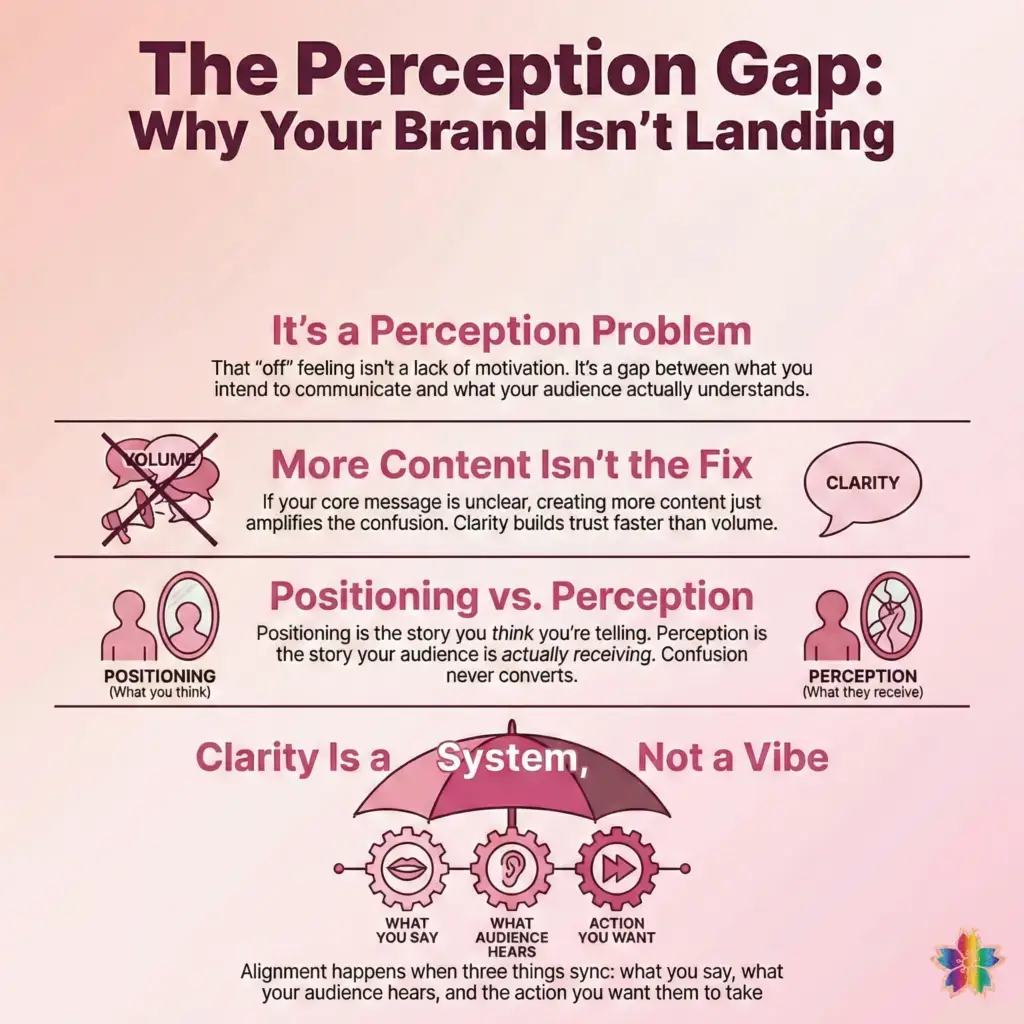
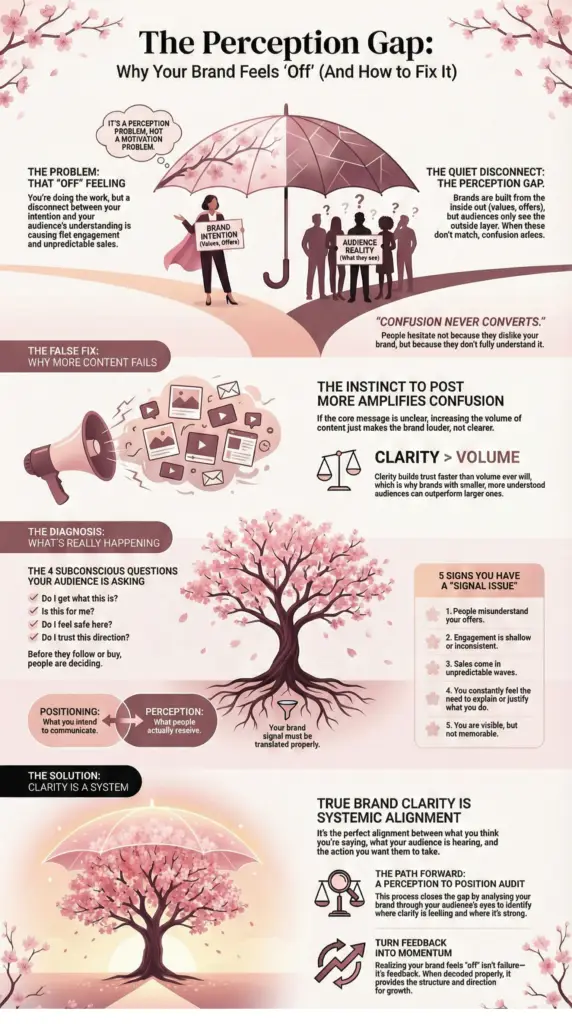
It’s a perception problem.
The quiet disconnect most people miss
Most business owners build from the inside out.
You know your values.
You know your offer.
You know your story.
But your audience only sees the outside layer.
What they perceive and what you intend are not always the same thing.
That gap is where things start to feel weird.
Your content isn’t wrong.
Your strategy isn’t broken.
But the signal you’re sending isn’t matching the story you think you’re telling.
When that happens, people hesitate. Not because they don’t like you, but because they don’t fully understand you.
And confusion never converts.
Why more content doesn’t fix it
This is where most people go sideways.
When something feels off, the instinct is to post more.
More reels. More captions. More explaining. More offers.
But if the core message is unclear, more content just amplifies the confusion.
You end up louder, not clearer.
This is why brands with smaller audiences can outperform bigger ones.
They’re easier to understand.
Clarity builds trust faster than volume ever will.
Why Your Brand Feels Off to Your Audience
People make decisions in seconds.
Before they click.
Before they follow.
Before they buy.
They’re subconsciously asking:
Do I get what this person does?
Do I know who this is for?
Do I feel safe here?
Do I trust this direction?
If your brand feels off, it’s usually because one or more of those questions isn’t getting a clean answer.
Not because you didn’t answer it.
But because it didn’t land the way you thought it did.
Perception vs positioning
Here’s the part no one explains clearly.
Positioning is what you intend to communicate.
Perception is what people actually receive.
You can have strong positioning on paper and still be perceived as unclear, inconsistent, or hard to place.
That doesn’t mean you failed.
It means your brand hasn’t been translated properly yet.
Most people skip this step entirely.
They assume alignment instead of checking for it.
What “off” really means
When clients tell me their brand feels off, it usually shows up like this:
People ask questions that suggest they misunderstood the offer
Engagement exists, but it’s shallow or inconsistent
Sales come in waves instead of steadily
You feel the urge to constantly explain or justify what you do
You’re visible, but not memorable
That’s not an effort issue.
That’s a signal issue.
Clarity is not a vibe, it’s a system
Brand clarity isn’t about aesthetics.
It’s not about sounding polished.
And it’s definitely not about copying what works for someone else.
It’s about alignment between:
What you think you’re saying
What your audience is hearing
What action you want them to take
When those three line up, things start to move without force.
Content feels easier.
Offers feel cleaner.
You stop second-guessing every post.
This is where the Perception to Position Audit comes in
The Perception to Position Audit exists for one reason:
to close the gap between intention and reality.
It looks at your brand through the eyes of your audience, not your attachment to it.
It identifies where clarity is leaking and where alignment is already working.
It gives you a clear map instead of vague advice.
Not more content.
Not more pressure.
Just truth, structure, and direction.
Because once your brand feels right, everything else works better.
If your brand has felt off lately, that’s not failure.
That’s feedback.
And feedback, when decoded properly, becomes momentum.

Karen Hewitt